Connect
Access and synchronise information across existing systems, files and spreadsheets.
 Building Intelligent Ventures
Business Intelligence
Synchronise information across systems.
Interrogate it as one business.
Understand what needs attention.
Business Intelligence is for businesses whose data sits in different systems with no shared way to synchronise or interrogate it. Connect information across finance, CRM, operations, HR, ERP, specialist applications and spreadsheets — then ask questions across the whole business.
See Business Intelligence in action
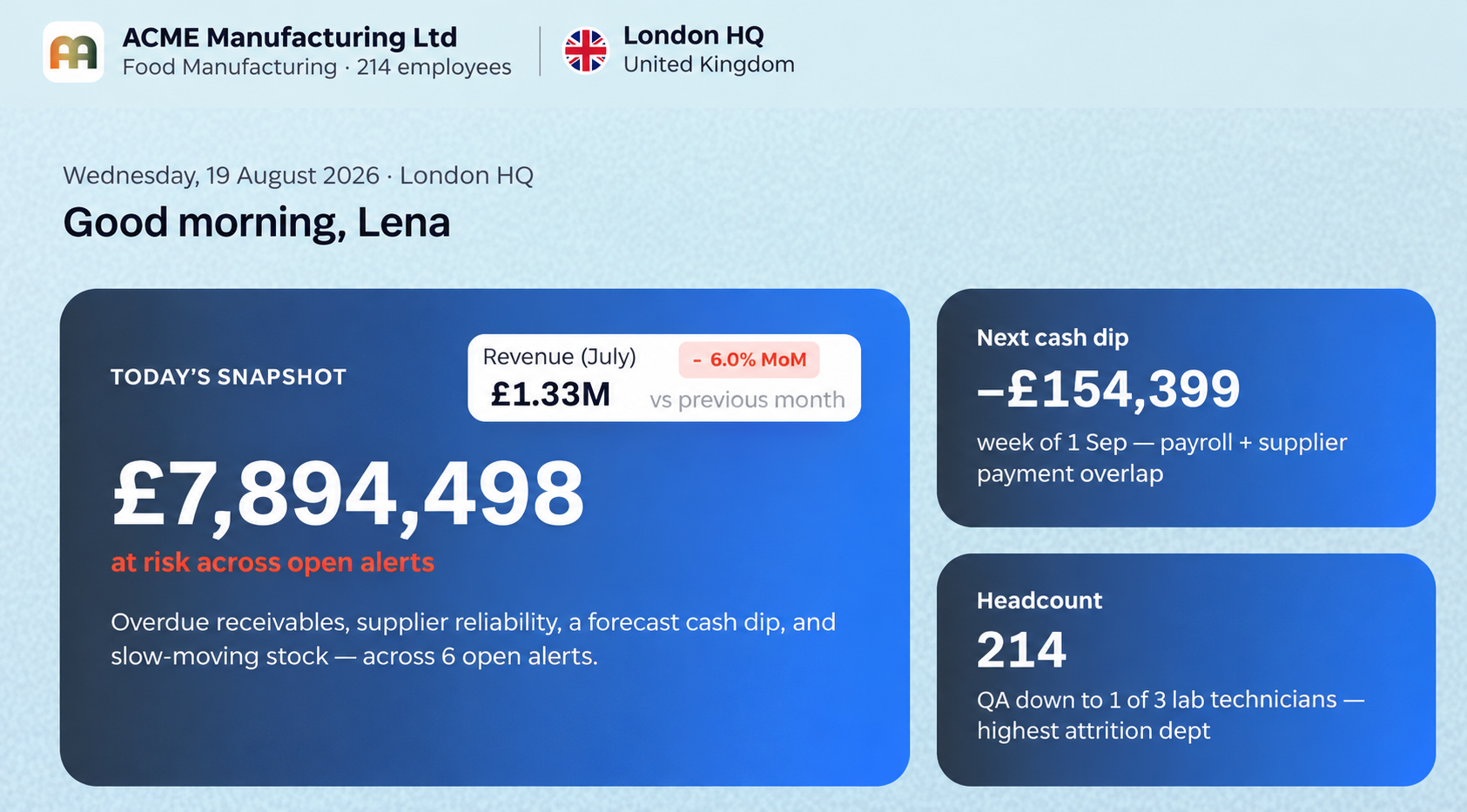
See how Business Intelligence turns fragmented business data into connected insight and prioritised action for management.
The management problem
Sales, finance, operations and people teams often work from separate systems and different versions of the same information. Business Intelligence helps synchronise and reconcile those sources so businesses can interrogate relationships, understand what is changing and identify where action is needed.
Which information agrees — and what needs reconciling?
How do sales, delivery and finance connect?
What is affecting performance across departments?
What is changing, and why?
Which customers, services or activities create value?
Where should the business focus next?
From signals to management focus
Business Intelligence works above the technology you already use, synchronising and reconciling connected information so it can be interrogated across systems. Explore relationships between customers, transactions, resources and activity; automate recurring analysis; and connect exceptions with business impact. Recommendations remain traceable to source records and under human control.
Access and synchronise information across existing systems, files and spreadsheets.
Compare numbers and flag mismatches.
Ask cross-system questions and explore causes, relationships and business impact.
Rank issues by value, urgency and confidence.
Prepare governed, approval-ready next steps.
Cross-business use cases
Connect CRM, sales, delivery and finance to understand customer, product or service performance.
Relate inventory, assets, commitments and finance to see where resources or cash are tied up.
Compare purchasing, supplier and financial records to investigate spend, price changes and cost pressure.
Link workload, staffing, utilisation and delivery data to understand bottlenecks and operating performance.
Connect invoices, customer records and payment activity to prioritise follow-up and understand cash exposure.
Bring reporting across departments together and investigate the drivers behind changing numbers.
Works across existing finance, CRM, ERP, HR, operational and specialist systems, files and spreadsheets. Connections and synchronisation are configured for each business and its available interfaces.
Business Intelligence value model
Use your own operating baseline to explore first-year and recurring value. Pricing assumptions are carried over from the original Business Intelligence model and should be confirmed for a proposal. All figures are USD.
For businesses with disconnected data
Reconcile information across systems and relate financial outcomes to customers, activity and operational causes.
Connect delivery, workforce, resource and customer information to understand operating performance.
Interrogate information across functions, identify priorities and make decisions from a shared view of the business.
Evidence before scale
Agree the workflow, current effort and value measures. Prove a contained problem against a baseline, then expand when the evidence supports it.
For partners
Explore partnership opportunities for business-system and software partners, advisory and transformation firms, and implementation specialists.
Discuss partnership fit ↗